Mass-energy equivalence, made practical
Convert mass, energy, light, and photons.
Enter the quantities you know. EISMC² fills the rest using compatible SI units, keeping Einstein's most famous relationship visible while you work.
Interactive calculator
Known values
Type numbers into any fields. Calculated fields are labelled automatically; edit a calculated value to make it one of your known values.
Formula sheet
Relationships used by this page
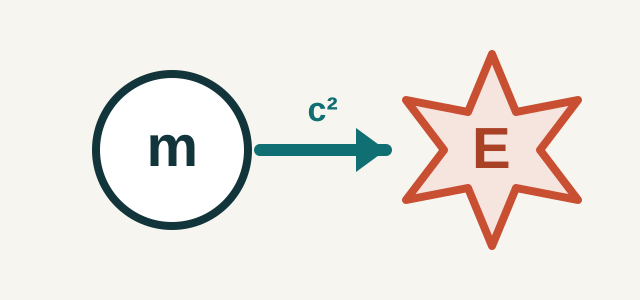
- E = mc2Energy equals mass times the speed of light squared.
- m = E/c2Mass can be read as the mass equivalent of an energy.
- E = hfA photon's energy equals Planck's constant times frequency.
- c = fλLight speed equals frequency times wavelength in vacuum.
- E = hc/λPhoton energy can be found from wavelength.
- p = E/cPhoton momentum equals energy divided by the speed of light.
- 1 eV = 1.602176634 x 10⁻¹⁹ JElectronvolts convert particle-scale energy to joules.
- 1 kWh = 3.6 x 10⁶ JKilowatt-hours convert everyday electrical energy to joules.
- 1 kg TNT = 4.184 x 10⁶ JTNT equivalent gives a familiar energy scale.
Reference
Units and symbols
All calculations use SI units internally. The exact constants are editable so you can explore the relationships, then recalculate them when needed.
- E
- Energy, measured in joules J.
- m
- Mass, measured in kilograms kg. A lowercase m can also mean metres when used as a unit.
- c
- Speed of light in vacuum, exactly 299,792,458 metres per second.
- f
- Frequency, measured in hertz Hz, or cycles per second.
- λ
- Wavelength, measured in metres m.
- h
- Planck constant, exactly 6.62607015 x 10⁻³⁴ joule seconds.
- p
- Photon momentum, measured in kilogram metres per second, kg m/s.
- eV
- Electronvolt, a particle-physics energy unit equal to 1.602176634 x 10⁻¹⁹ joules.
- kWh
- Kilowatt-hour, an energy unit equal to 3,600,000 joules.
- TNT
- One kilogram of TNT equivalent is defined here as 4,184,000 joules.